
Key Takeaways:
South Florida cap rates have compressed to 4.5–5.5% for multifamily — near historic lows — creating a seller’s window
1031 exchanges let you defer 100% of capital gains + depreciation recapture, but strict timelines (45/180 days) kill deals
The hold/sell decision comes down to three variables: your cost basis, your replacement property options, and your time horizon
The 2026 Market Context: Why This Question Matters Now
The numbers have shifted in ways that demand a fresh calculation. Multifamily cap rates in Broward and Miami-Dade sit at 4.5–5.5% — the tightest they’ve been in a decade. That means buyers are paying 18–22x NOI for income streams. Three years ago, those same assets traded at 6–7% caps. If you bought at a 6.5% cap in 2021, your paper equity has grown 30–40% purely from cap rate compression, not operational improvement.
At the same time, insurance costs have risen 40%+ since 2022, property taxes are reassessing at higher values, and the Fed’s rate path remains uncertain. The cost of carrying leveraged assets is climbing while the price buyers will pay has peaked. That tension — high exit prices, rising carry costs — is exactly when disciplined investors make the sell/hold decision instead of defaulting to inertia.
The Three Variables That Drive Every Decision
Before you run a single spreadsheet, you need clarity on three inputs. Everything else is noise.
1. Your Effective Cost Basis (Not What You Paid)
Most investors anchor to purchase price. The IRS anchors to adjusted basis: purchase price + capital improvements – depreciation taken. On a property held five years with $150K in improvements and $200K in depreciation, your tax basis might be $150K below what you think. That gap determines your real tax exposure on sale — and your 1031 replacement requirement.
2. Your Replacement Property Universe
A 1031 exchange only makes sense if you can deploy the proceeds into something that improves your position: higher cash-on-cash, better appreciation trajectory, lower management burden, or geographic diversification. If the only replacement properties available are 4.5% cap assets with deferred maintenance, you’re exchanging one problem for another. The 45-day identification window forces this search before you’re ready.
3. Your Time Horizon and Liquidity Needs
Are you building generational wealth (20+ year horizon) or funding a life event in 3–5 years? The former favors hold-and-refinance; the latter favors harvest-and-redeploy. There’s no wrong answer — only misalignment between asset strategy and life strategy.
The Decision Matrix: Score Your Position
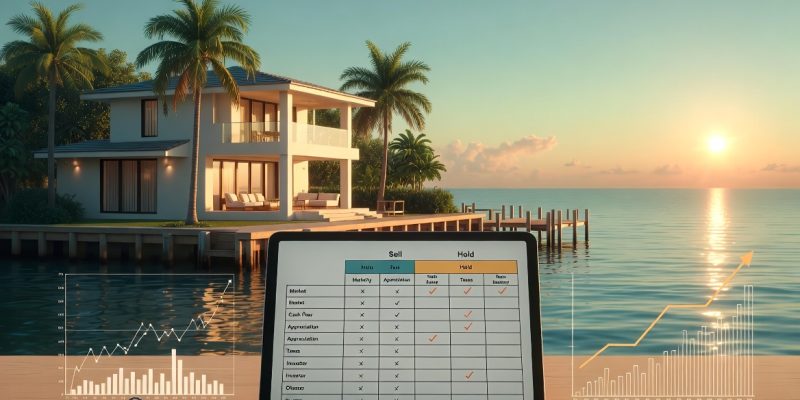
Use this framework quarterly. Write down your score for each factor. The pattern reveals the answer.
Hold Signals (Score 1 point each)
| Factor | Your Situation |
|---|---|
| Cap rate spread | Current cap rate ≥ 100 bps above your purchase cap rate |
| Rent growth runway | Submarket rents projected +4%+ annually for 3+ years |
| Value-add upside | Uncaptured NOI potential >15% (renovations, fee income, expense reduction) |
| Financing advantage | Existing debt <5.5% fixed, 5+ years remaining, assumable |
| Tax basis protection | Adjusted basis >80% of FMV (low gain exposure) |
| Portfolio fit | Asset aligns with long-term strategy (geography, asset class, management style) |
| 1031 replacement gap | No identified replacement assets meeting criteria |
| Life horizon | 10+ year hold horizon, no liquidity need |
Sell Signals (Score 1 point each)
| Factor | Your Situation |
|---|---|
| Cap rate compression | Current cap rate ≤ 50 bps above purchase cap (peak pricing) |
| Rent growth exhaustion | Submarket rents flat/declining or at affordability ceiling |
| Operational ceiling | Asset fully optimized — no meaningful NOI upside remaining |
| Debt maturity wall | Balloon/refi within 24 months at projected >7% rates |
| Tax efficiency | Stepped-up basis opportunity (estate planning) or QOF eligibility |
| Concentration risk | Single asset >25% of portfolio or single-market overexposure |
| Management fatigue | Disproportionate time/capital required vs. portfolio average |
| Life event liquidity | Capital needed for acquisition, education, retirement, estate |
Interpretation: 5+ hold signals → Hold. 5+ sell signals → Sell. 4–4 split → Refinance or partial disposition. The middle zone is where strategy lives.
The 1031 Exchange Reality Check
Everyone mentions 1031 as the default answer. Few execute it cleanly. Here’s what actually happens in South Florida 2026.
The Timeline That Kills Deals
| Deadline | Requirement | Typical Failure Point |
|---|---|---|
| Day 0 | Close sale → proceeds to QI | Seller delays closing, QI not pre-selected |
| Day 1–45 | Identify ≤3 replacement properties (or 200% rule) | Market inventory mismatch, seller hesitation, analysis paralysis |
| Day 46–180 | Close on identified property(ies) | Financing delays, inspection surprises, title issues |
| Day 181+ | Exchange fails → full tax recognition | Zero flexibility — no extensions |
South Florida specific: Inventory of quality multifamily at reasonable caps is thin. The 45-day identification window often forces investors into “placeholder” properties they don’t want, just to keep the exchange alive. We’ve seen clients identify three properties, lose two to competing offers, and scramble to close the third with days to spare. That’s not strategy — that’s survival.
When 1031 Makes Sense (And When It Doesn’t)
| Scenario | 1031 Verdict | Alternative |
|---|---|---|
| High gain, low basis, strong replacement pipeline | ✓ Execute | — |
| Moderate gain, identified replacement under contract | ✓ Execute | — |
| High gain, no replacements identified, hot market | ✗ Risky | Pay tax, deploy net proceeds freely |
| Low gain, depreciation recapture dominant | ✗ Limited benefit | Cost segregation on replacement instead |
| Portfolio simplification needed | ✗ Complicates | Sell, pay tax, consolidate |
| Estate planning horizon | ✗ Unnecessary | Step-up at death eliminates gain |
The math most miss: If your effective tax rate on sale (cap gains + recapture + NIIT + state) is 25–30%, and you can redeploy net proceeds at a 100–150 bps higher yield than your current asset, you break even in 3–5 years without the 1031 constraints. Run that calculation before you commit to the timeline.
The Refinance Alternative: Harvest Equity Without Selling
For investors scoring in the middle zone, a cash-out refinance often solves the liquidity vs. upside dilemma.
| Metric | Current Asset (Hold) | Cash-Out Refi | Sell + 1031 |
|---|---|---|---|
| Equity extracted | $0 | 65–75% LTV | 100% (less closing costs) |
| Tax event | None | None | Deferred (if 1031) |
| Debt service | Unchanged | Increases | Resets on replacement |
| Upside retention | 100% | 100% | Transfers to replacement |
| Management burden | Unchanged | Unchanged | New asset, new issues |
| Flexibility | Low | Medium | Low (timeline locked) |
| Best for | Long-term hold, no cash need | Liquidate 20–30% equity, keep upside | Full reposition, clear replacement |
South Florida 2026 lending reality: DSCR loans at 6.75–7.25% fixed, 30-year amortization, 70% LTV max on multifamily. If your current debt is sub-5%, the spread on new money is 200+ bps. Run the marginal cost of that incremental debt against the yield on redeployed capital. Often, keeping the cheap debt and only extracting excess equity (above 70% LTV on current NOI) is the optimal play.
Case Study: The Plantation 12-Unit Decision
Client: Denver-based investor, purchased 12-unit garden complex in Plantation 2019 for $2.1M (6.2% cap). Current NOI: $165K. Market value: $3.3M (5.0% cap). Debt: $1.3M at 4.1% fixed, 7 years remaining.
Decision Matrix Score:
Hold signals: Cap rate spread (120 bps) ✓, Rent growth ✓, Financing advantage ✓, Tax basis protection (basis $1.6M vs FMV $3.3M) ✓, Life horizon (15 yr) ✓ = 5
Sell signals: Cap rate compression (at 5% market) ✓, Operational ceiling (renovated 2021) ✓, Concentration risk (40% of portfolio) ✓ = 3
Initial lean: Hold.
But: Concentration risk was real. 40% of net worth in one 1970s asset in one submarket. The investor also wanted to diversify into Texas/Sun Belt growth markets.
Solution executed: Partial 1031 + Refinance Hybrid
Refinanced at 65% LTV on current NOI → pulled $450K tax-free cash
Used $450K + $150K reserves as 25% down on two 8-unit properties in Dallas/Fort Worth (6.8% cap, 2023 vintage)
Retained Plantation asset with $1.75M new debt (still <70% LTV), 4.1% rate unchanged on $1.3M, new $450K at 7%
Identified TX properties within 45 days (under contract pre-sale)
Closed 1031 on one TX property ($1.2M) to defer gain on that portion; paid tax on remaining $2.1M gain ($525K tax)
Result: Diversified into two markets, improved blended cap rate to 5.9%, retained Plantation cash flow, managed tax hit
Outcome 18 months later: Plantation NOI grew to $178K (rent growth). TX assets performing at pro forma. Blended portfolio yield 7.2% vs. 5.0% pre-rebalance. Investor calls it “the best decision I didn’t know I could make.”
The South Florida Submarket Exit Timing Guide
Not all neighborhoods peak simultaneously. Know where your asset sits in the cycle.
| Submarket | Cycle Phase | Cap Rate Trend | Sell Window | Hold Thesis |
|---|---|---|---|---|
| Downtown Fort Lauderdale | Late expansion | Compressing (4.5–5.0%) | Now — peak pricing | Limited supply, but new delivery wave 2027–2028 |
| Victoria Park / Rio Vista | Peak | Trough (4.5%) | Now — irreplaceable location | Land value > improvement value |
| Hollywood / Hallandale East | Early expansion | Stable (5.0–5.5%) | 12–24 months | Redevelopment path, transit investment |
| Pompano Innovation District | Early recovery | Stabilizing (5.5–6.0%) | Hold — 24–36 month upside | Commercial conversion, city investment |
| Weston / Davie / Plantation | Mature stability | Stable (5.0–5.5%) | Hold unless life event | Schools, demographics, limited supply |
| Doral / West Kendall | Late expansion | Compressing (4.8–5.2%) | Now — corporate demand peak | New supply pipeline 2026–2027 |
| North Miami / El Portal | Early gentrification | High (6.0–7.0%) | Hold — 36+ month horizon | Path of progress, but execution risk |
Rule of thumb: If your submarket is in “Peak” or “Late Expansion” and you have 3+ sell signals → list. If “Early Recovery” or “Early Gentrification” and 3+ hold signals → refinance and wait.
Tax Scenario Modeling: What You Actually Keep
| Sale Price | $3,300,000 |
|---|---|
| Original Basis | $2,100,000 |
| Capital Improvements | +$150,000 |
| Depreciation Taken | -$200,000 |
| Adjusted Basis | $2,050,000 |
| Total Gain | $1,250,000 |
| Depreciation Recapture (25%) | $200,000 × 25% = $50,000 |
| Long-Term Cap Gain (20%) | $1,050,000 × 20% = $210,000 |
| NIIT (3.8%) | $1,250,000 × 3.8% = $47,500 |
| Total Federal Tax | $307,500 |
| Net Proceeds After Tax | $1,592,500 (on $1.25M gain = 75.4% retention) |
| 1031 Deferral | $307,500 stays invested → ~$24,600/yr additional yield at 8% |
The question: Can you deploy the full $3.3M (via 1031) into assets yielding 8%+? Or deploy $1.59M (after tax) into assets yielding 10%+? The latter often wins on flexibility alone.
Free Sell vs. Hold Analysis: Your Starting Point
We’ll model your specific asset: current FMV, adjusted basis, debt structure, submarket cycle position, replacement property options, and tax scenarios — both 1031 and pay-tax. You get a decision memo with scores, projections, and a recommended path. No obligation. 72 hours.
Get Your Free Sell vs. Hold Analysis →
Frequently Asked Questions:
Can I do a partial 1031 exchange?
Yes. Exchange a portion of the proceeds, pay tax on the rest. The “boot” (cash taken) is taxed first — depreciation recapture, then cap gain. We structure this regularly for clients who want diversification and deferral.
What if I can’t find a replacement property in 45 days?
The exchange fails. Full tax recognition. This is why we pre-identify replacement inventory before listing your sale property. Our buyer network and off-market pipeline exist partly for this reason.
Can I 1031 into a REIT or DST (Delaware Statutory Trust)?
Yes — both qualify as like-kind. DSTs offer passive ownership, professional management, and fractional access to institutional assets. But: illiquid, fees 1.5–2.5%/yr, no control. We offer DST access but only for specific client profiles.
What about Opportunity Zones?
If your gain is from any asset sale (not just real estate), you can invest in a Qualified Opportunity Fund within 180 days. 10% basis step-up at 5 years, 15% at 7 years, zero cap gain on QOF appreciation at 10 years. South Florida has designated OZ tracts. Different tool, different timeline — we model both.
How does Florida’s lack of state income tax affect this?
Massive advantage. No state cap gains tax = 5–13% savings vs. NY/CA/NJ/CT. Your effective federal-only rate ~25–30% vs. 35–40%+ in high-tax states. This makes selling relatively more attractive in FL than in tax states.
Can I refinance instead of selling to access equity?
Yes — and often should. See the Refinance Alternative section. Key constraint: DSCR loan max 70% LTV, current rates 6.75–7.25%. If your existing debt is cheap, only extract excess equity above that threshold.
What if I want to sell to my kids / family?
Related-party 1031 rules are strict: buyer must hold 2 years, no basis shifting. Often better: sell at FMV, pay tax, gift net proceeds (annual exclusion + lifetime exemption). Or installment sale for income spreading. We coordinate with estate attorneys.
How do I know if my property is “fully optimized”?
If you’ve: renovated units to market max, implemented RUBS/utility recovery, optimized insurance via mitigation credits, appealed property taxes, negotiated vendor contracts, and rent growth matches market — you’re optimized. Most owners miss 2–3 of these.
Your Quarterly Decision Ritual
Don’t make this a once-in-a-lifetime event. Put it on the calendar.
| Quarter | Action |
|---|
| Quarter | Action |
|---|---|
| Q1 | Update FMV (broker opinion + comps), recalc cap rate, review debt maturity |
| Q2 | Run decision matrix, update replacement property watchlist |
| Q3 | Model tax scenarios (1031, pay-tax, refinance), consult CPA |
| Q4 | Execute or recommit — document rationale in investor memo |
The investor memo: One page. Asset, score, thesis, trigger conditions for action. Next quarter you read last quarter’s memo. If nothing changed, you hold with conviction. If something changed, you act with clarity.
Ready to Make the Call With Data, Not Gut?
The sell vs. hold decision is the highest-leverage decision in your portfolio. Most investors make it once per asset — at purchase. The disciplined few make it every quarter. ACCRIVE gives you the data, the models, and the execution capacity to act when the math says act.
Three ways to start:
Schedule a Portfolio Strategy Call — 30 minutes, we run your top asset through the matrix live
Request Your Free Sell vs. Hold Analysis — Full tax, refi, 1031, and replacement modeling
Explore Current Replacement Inventory — Off-market multifamily in FL, TX, GA, NC with pro formas